

UK Grades to US GPA: Conversion Guide
Applying to an American university or looking for work in the United States with a British academic background can be incredibly stressful. You look at your transcript with percentages like 65% or 72%, and you realize that US admissions offices are looking for a completely different number: a Grade Point Average capped at 4.0.
If you try to convert these numbers using standard mathematical percentages, your application might look like a disaster. A 70% in the UK is an exceptional mark, but to an uneducated American eye, it looks like a barely passing 'C'.
To successfully apply abroad, you must understand how to accurately map uk grades to us gpa. Getting this translation right ensures that your academic hard work is evaluated fairly by international admissions teams.
The Cultural Scale Shock
Related reading: Check out our guide on Yenching Academy Scholarship China: Apply
The primary issue when translating grades between the two countries is the philosophical approach to evaluation. In the US, the grading system operates on a deduction model. You start with 100%, and if you follow instructions and perform well, you keep most of those points. Getting a 90% or higher (an 'A') is standard for top students.
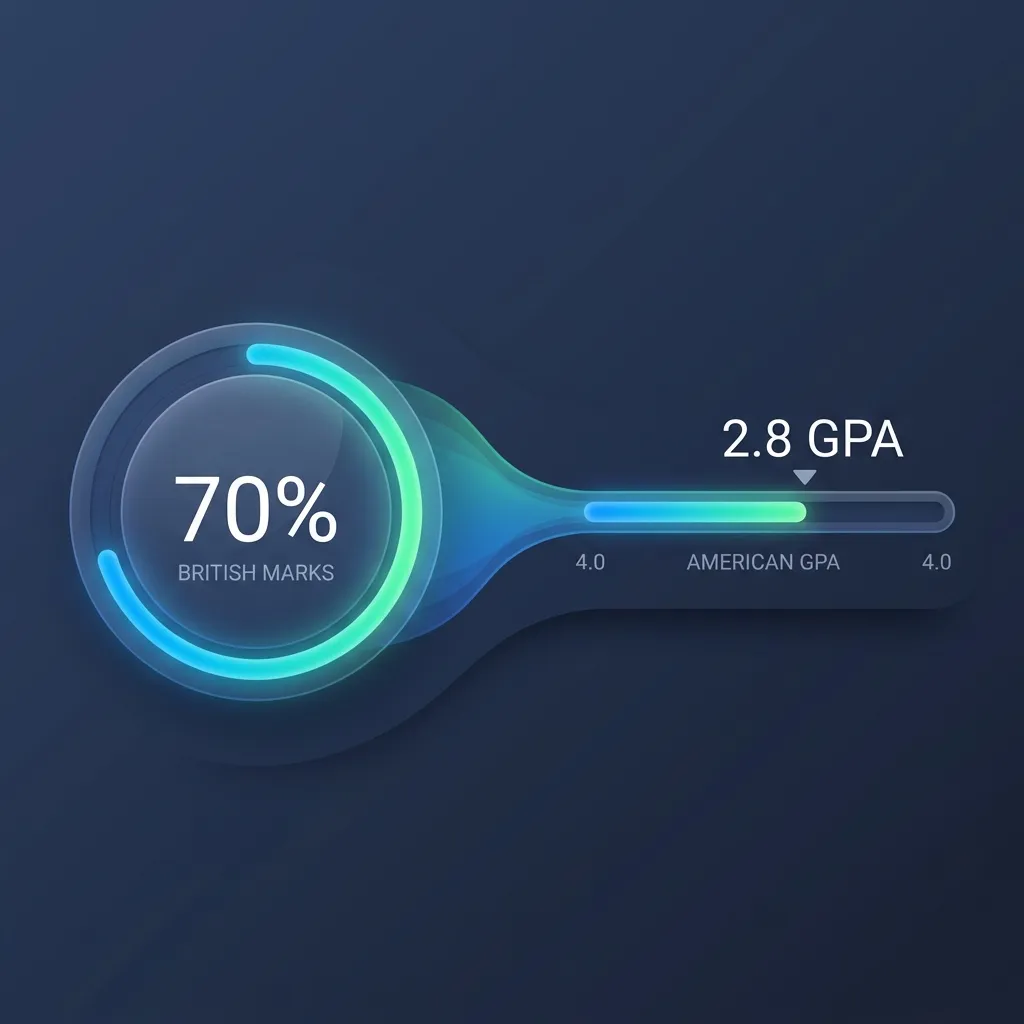
The British system is entirely different. It uses an accumulation model where a 100% is mathematically near-impossible to achieve. Professors reward original thinking, rigorous critique, and extensive external research.
Because of this, a score of 70% is not a mediocre performance; it represents a First-Class Honors designation, which maps to the highest tier of American achievement.
Step-by-Step Translation Matrix
While individual universities in the US handle international applications using their own internal guidelines, there are widely accepted industry standards for converting undergraduate degrees.
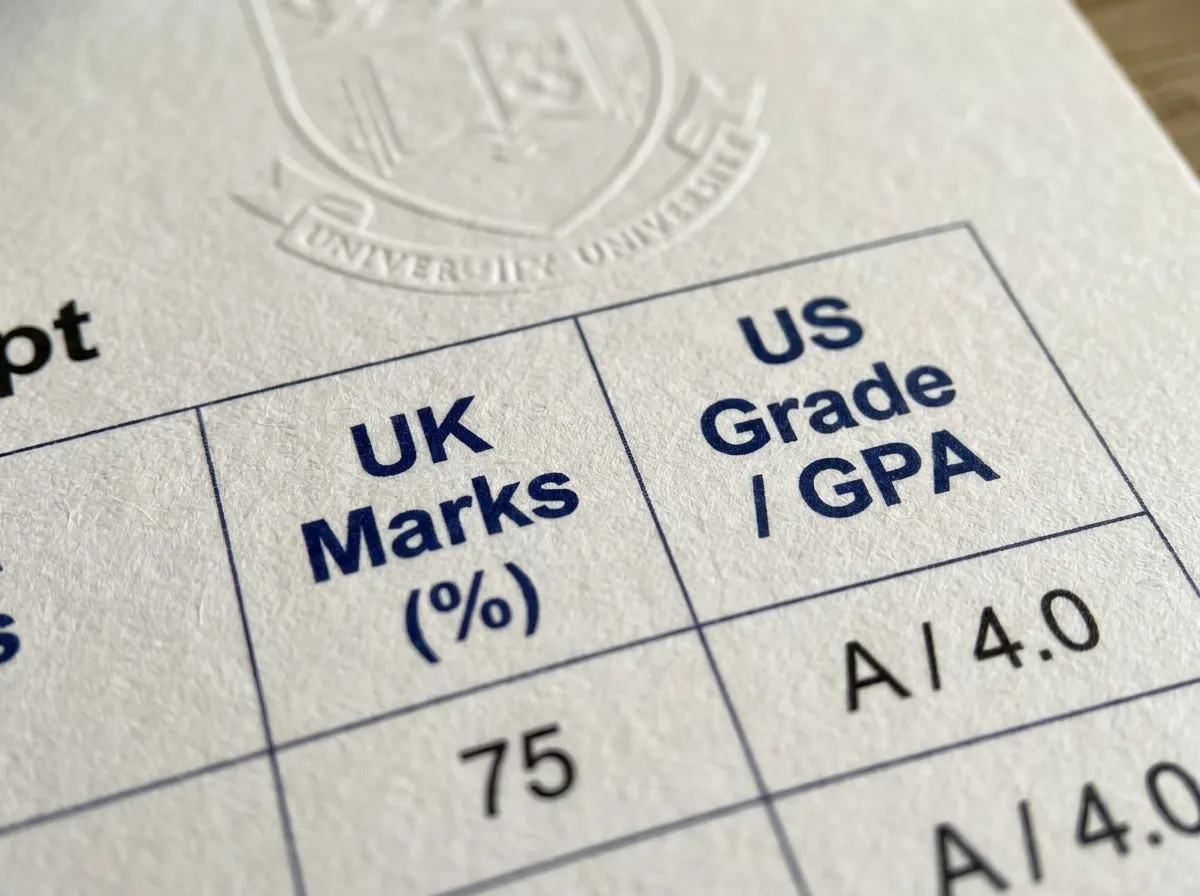
| UK Degree Classification | UK Percentage Range | Equivalent US Letter Grade | Estimated US GPA Equivalent |
| First-Class Honors | 70% to 100% | A / A+ | 4.0 |
| Upper Second-Class (2:1) | 60% to 69% | B+ / A- | 3.3 to 3.7 |
| Lower Second-Class (2:2) | 50% to 59% | B- / B | 2.7 to 3.0 |
| Third-Class Honors | 40% to 49% | C / C+ | 2.0 to 2.3 |
| Ordinary / Pass | 35% to 39% | D | 1.0 |
| Fail | Below 35% | F | 0.0 |
Pro Tip: If your average sits at 68% or 69%, do not automatically assume you are locked out of a top-tier GPA equivalent. US admissions committees look closely at your trend line and your performance in your specific major modules rather than just your final average score.
The Unfair Math Trick: Why WES Matters
If you try to calculate your own average by taking individual module percentages and converting them one by one, you will likely end up with an inaccurate result. This is because raw percentages do not account for the curve of British class distributions.
To get an official, legally binding translation, you will usually need to use a third-party evaluation agency. The most popular service is the World Education Services (WES).
Using an official service prevents your application from being filtered out by automated applicant tracking software. These systems are often pre-programmed with rigid US algorithms that do not automatically recognize the value of a British 2:1 or First-Class degree.
The Postgraduate Exception
If you are converting UK Master's degrees, the metrics shift again. British postgraduate programs use three main designations: Distinction, Merit, and Pass.
-
A Distinction (typically 70% or higher) translates cleanly to a 4.0 GPA.
A Merit (typically 60% to 69%) generally converts to a solid 3.0 to 3.5 range.
A Pass (50% to 59%) usually lands right around a 3.0 baseline, which is often the minimum requirement to maintain good standing in an American graduate school.
Because American graduate applications place immense weight on letters of recommendation and your personal statement, a close 2:1 or Merit can easily compete with domestic 4.0 applicants if your research profile is strong.
Action Plan for Applicants
To make sure your qualifications aren't misunderstood, follow this sequence when prepping your submission materials.
Step 1.Check the specific university requirements:
Review the international admissions page for every US university on your list. Some schools perform their own internal conversions of uk grades to us gpa and explicitly request that you do not purchase a third-party report.
Step 2.Secure your official transcript:
Request a comprehensive academic transcript from your UK university registry. Ensure it includes individual module marks, credit hours (CATS credits), and an official explanation of the university's grading scheme on the back.
Step 3.Select an accredited evaluation service:
If required, submit your files to an agency member of NACES (National Association of Credential Evaluation Services). Request a course-by-course evaluation rather than a general document evaluation to ensure your credits transfer properly.
Summary of Conversion Insights
Achieving a fair translation requires looking past raw percentages. Keep your eyes on these core conversion principles:
-
Honors Tier Dominance: Your final degree classification (First, 2:1, 2:2) matters far more to US institutions than individual low-percent module marks from your first year of study.
Credit Value Halving: A standard UK academic year equals 120 CATS credits. This converts precisely to 30 US semester credit hours. Your 10-credit UK modules are worth roughly 2.5 US credits.
Contextual Advantage: High marks in your third-year dissertation or capstone project carry immense weight during holistic American review processes.
Frequently Asked Questions
Yes. An Upper Second-Class Honors (2:1) degree generally equates to a 3.3 to 3.7 GPA range. While Ivy League schools favor top-tier marks, a strong 2:1 paired with great GRE/GMAT scores, deep research experience, or unique extracurriculars makes you a competitive candidate.
A-Levels are highly respected in the United States. An 'A' or 'B' grade on an A-Level exam typically translates to an 'A' grade in the US system. Furthermore, many American colleges award advanced sophomore course credit for strong A-Level marks, saving you tuition cash.
In the UK, first-year grades often don't count toward your final degree classification. However, American universities review your entire academic history. They will see your first-year marks on your transcript, but they prioritize positive trajectory and growth.
NACES is the National Association of Credential Evaluation Services. It is an association of independent credential evaluation companies. Most US universities require that your international grade translations come from a certified NACES member to guarantee authenticity.
Yes, absolutely. In the British university system, any mark above 70% falls into the First-Class category. Because a First-Class represents top-tier performance, credential evaluators translate scores from 70% to 100% as a 4.0 average.