
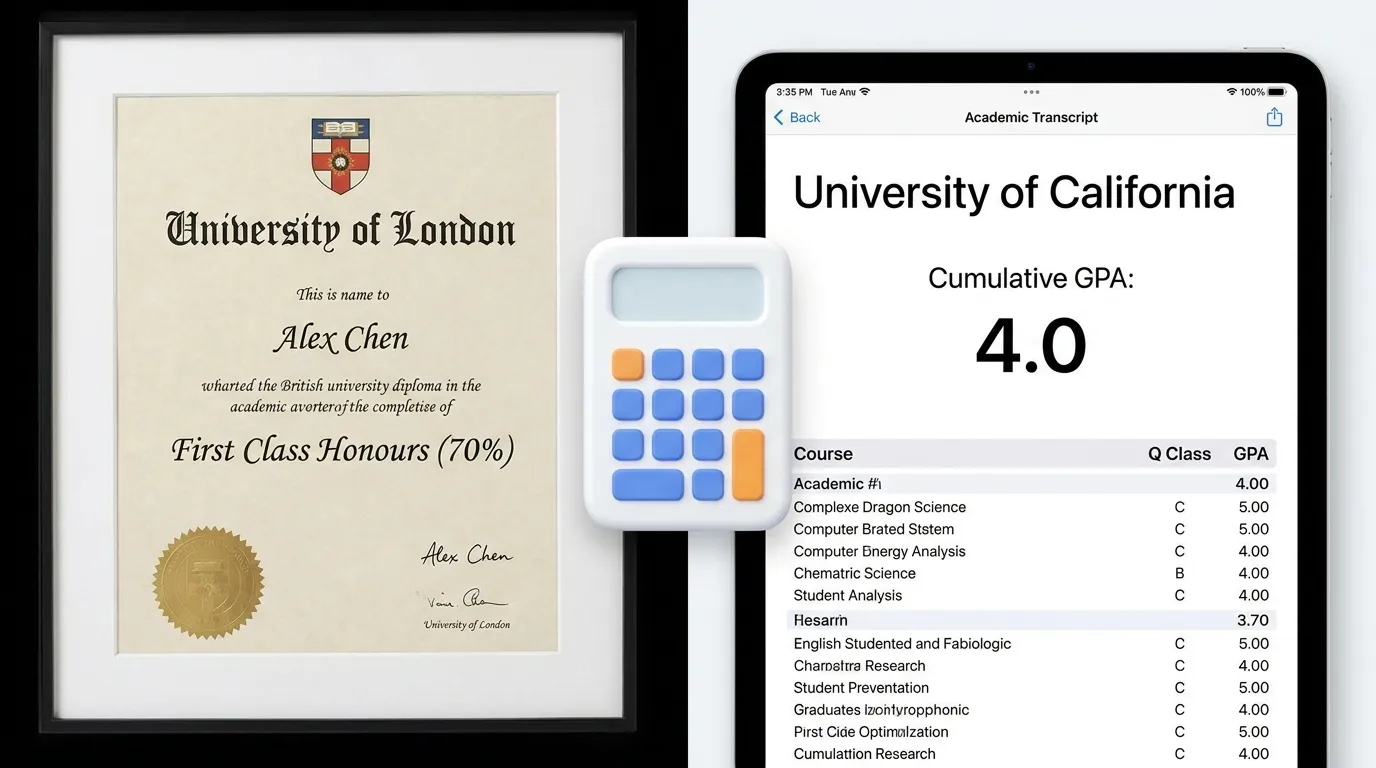
Convert UK Marks to GPA: Easy Online Calculator Guide
If you are a student transitioning from the UK higher education system to a university in the United States, you will quickly face a frustrating roadblock. Your British academic transcripts are full of percentages and honors classifications, but US admissions offices want a 4.0 Grade Point Average (GPA).
Trying to decipher how your hard-earned 2:1 or First-Class degree translates across the Atlantic can feel like learning a completely new language.
The good news is that mapping these two distinct systems does not have to involve complex mathematical formulas. This guide will walk you through exactly how the conversion works, break down the standard cross-atlantic grading scales, and show you how to use a uk marks to gpa calculator to get your accurate score in seconds.
Understanding the Core Differences
Related reading: Check out our guide on How to Apply for Gates Cambridge Scholarship
To successfully convert uk marks to gpa, you first need to understand that the two grading philosophies are fundamentally different.
In the United States, the grading scale is highly cumulative. Getting a 90% or above is a standard requirement to secure an "A." Professors grade heavily on consistent assignments, quizzes, and regular attendance throughout the semester.
In contrast, the United Kingdom utilizes a much stricter, standard-based percentage scale. In a British university, scoring a 70% is considered outstanding and marks the threshold for a First-Class Honors degree. Getting a 90% or higher on a UK university exam is incredibly rare.
The image below outlines how these structural elements differ before you dive into the numbers.
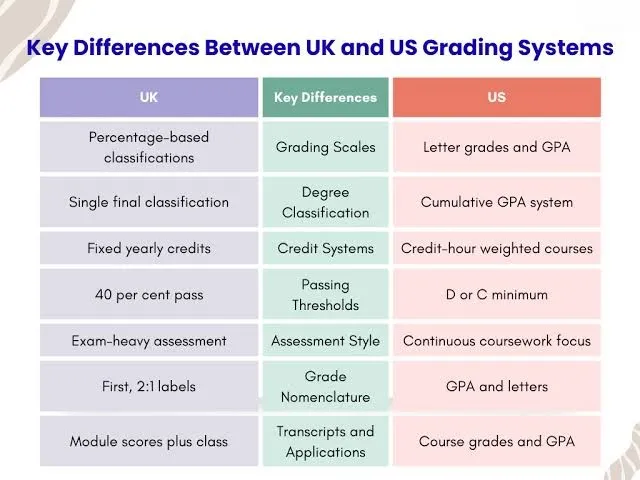 CaptionStructural differences between UK and US higher education grading
The Standard UK to US Conversion Scale
Because a 70% in London means something entirely different than a 70% in New York, academic evaluation services use a standardized mapping system. When you use a digital tool to convert uk marks to gpa, it relies on these widely accepted academic benchmarks:
| UK Undergraduate Class | UK Percentage Range | Equivalent US Letter Grade | Estimated US GPA |
| First-Class Honors (1st) | 70% to 100% | A | 3.7 to 4.0 |
| Upper Second-Class (2:1) | 60% to 69% | B+ / B | 3.3 to 3.6 |
| Lower Second-Class (2:2) | 50% to 59% | B- / C+ | 2.7 to 3.2 |
| Third-Class Honors (3rd) | 45% to 49% | C | 2.3 to 2.6 |
| Ordinary / Pass | 40% to 44% | D | 2.0 |
| Fail | Below 40% | F | 0.0 |
Pro-Tip: Many top-tier US graduate schools recognize that a 65% to 68% in the UK represents highly rigorous work. Don't panic if your raw British score looks "low" on paper; admissions committees evaluate the context of the British honors framework.
How to Convert UK Marks to GPA Steps
If you want to manually estimate your standing or verify what an online application tool outputs, follow this systematic breakdown.

1. Gather Your Official Transcripts
Collect your official module marks and your specific credit values for every completed year of study. Do not guess your scores, as even a minor percentage shift can alter your final tier.
2. Map Module Scores to the 4.0 Scale
Look at each individual module percentage and use the conversion table above to assign it a corresponding US value (e.g., a module score of 65% becomes a 3.5).
3. Factor in the Credit Weight
Multiply each converted score by the number of UK credits allocated to that specific module. For instance, a 30-credit module impacts your final average twice as much as a 15-credit module.
4. Divide by Total Credits
Add up all of your calculated quality points and divide that number by your total completed UK credits. This final number is your estimated cumulative 4.0 score.
The Overlooked Trap: The Danger of "Raw" Percentages
The single biggest mistake international students make is inputting raw percentage marks directly into generic US math tools.
If you type a 65% into a basic American grade converter, it assumes you failed or achieved a low "D" grade. In reality, a 65% places you solidly in the Upper Second-Class (2:1) bracket, which is highly competitive and equivalents to a strong "B+" or a 3.5 average in America.
Always ensure the platform you use explicitly states it is configured for british grades to us gpa translation.
The Crucial Difference Between Weighted and Unweighted Math
Another point that trips up applicants is credit volume discrepancies. UK modules are typically worth 15, 30, or 60 credits, while US courses generally award 3 or 4 credits.
A dedicated uk marks to gpa calculator automatically scales these weights proportionately, ensuring a minor elective course does not unfairly skew the weight of your primary dissertation or capstone modules.
Unique Value: What Admissions Committees Actually Look For
While having an online tool provide a fast estimate is great for filling out initial digital profiles, elite global institutions often look past the raw numbers. Here is what is happening behind the scenes:
-
The Trend Analysis: US admissions officers look for upward trajectories. If your first-year marks were averaging 52% (2:2) but your final-year modules jumped to 68% (2:1), they value the growth over the rigid mathematical average.
WES Evaluation Standards: For official verification, most universities require a formal evaluation from agencies like World Education Services (WES). These official evaluations often yield a slightly higher score than free online tools because they meticulously adjust for course rigor and institutional prestige.
Summary & Next Steps
When preparing your international applications, learning how to accurately convert uk marks to gpa ensures your academic achievements are represented fairly. Remember that a 70% is a sign of excellence, a 2:1 is highly respectable, and credit weights must be factored into your final calculations.
Expert Tip: Use an online calculator as a benchmark for your personal resume, CV, or initial inquiries with professors. However, always check if your target university requires a formal third-party credential evaluation before you submit your final application. Good luck with your international academic journey!
Frequently Asked Questions
Yes, an Upper Second-Class Honors (2:1) degree generally converts to a US GPA between 3.3 and 3.6. This is widely considered a strong, competitive average that meets the entry requirements for most top-tier US graduate programs.
No. Regular mathematical tools assume that 60% or 70% is a failing or barely passing mark based on the US system. You must use a dedicated system built specifically to adapt British honors classifications to American standards.
Most admissions teams review your entire academic transcript. While your overall final degree classification (like a First or 2:1) is crucial, they will pay close attention to your performance in core subjects relevant to the degree you are applying for.
A British First-Class Honors degree is equivalent to a premier "A" grade in the United States, typically mapping out to a 3.7 to 4.0 score.
As a general rule of thumb, you can divide your UK credits by four to find the equivalent US semester credit hours. For example, a standard 15-credit British module is roughly equivalent to 3 to 4 US credit hours.