

Calculate Admission GPA for Top Global Universities
When you look at the admissions profiles of the world’s elite universities, the numbers can be intimidating. You see average incoming scores of 3.9 out of 4.0, or specific point requirements that look entirely different from your home school's transcript.
The biggest mistake you can make as an applicant is assuming that the cumulative score printed at the bottom of your report card is the exact number an admissions committee will look at.
Elite institutions rarely accept your school's math at face value. To truly understand where your application stands, you must know how to calculate admission gpa the exact same way elite admissions officers do behind closed doors.
The Myth of the Raw Transcript
Related reading: Check out our guide on How to Calculate Semester GPA Step by Step
Every high school and country uses a unique grading philosophy. Some schools award massive grade inflation, making an 'A' grade easy to achieve. Others practice intense deflation, where breaking a 90% threshold is a rare academic feat.
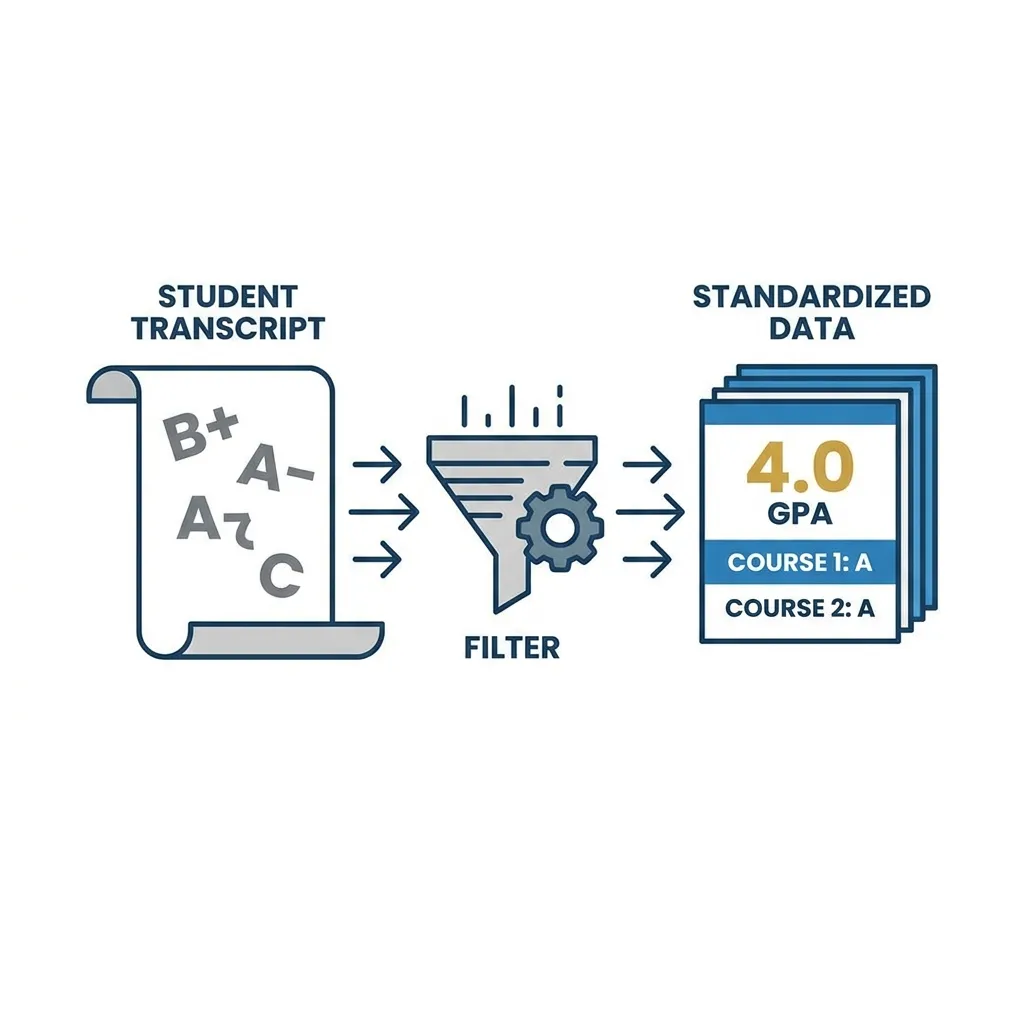
Top global universities are fully aware of this variation. They do not compare a raw 4.0 from an easy grading environment directly against a 3.7 from an incredibly rigorous curriculum.
Instead, admissions teams use standardized internal algorithms to strip away local variables. This normalization process ensures all applicants are evaluated on a balanced, universal metric.
Step-by-Step Blueprint to Normalize Your Scores
To get a clear, realistic look at your academic standing, you can reverse-engineer this normalization process at home.
1.Isolate Core Academic Subjects:
Review your transcript and completely remove non-academic courses like physical education, health, driver's education, or school office assistant credits. Top universities focus almost exclusively on core areas: English, Math, Sciences, Social Studies, and Foreign Languages.

2.Convert Marks to a Standard 4.0 Scale:
Translate your remaining core letter grades or percentages into the standard unweighted point system. Award 4 points for an A, 3 points for a B, 2 points for a C, 1 point for a D, and 0 points for an F. Ignore any plus or minus modifiers for your baseline unweighted math.
3.Factor In the Credit Hour Volume:
Multiply the point value of each core grade by the total number of credits or unit weights assigned to that specific class. Add these resulting quality points together, then divide that total sum by your overall number of core credits.
The Secret Recalculation Systems
The most critical factor that many standard web tools fail to tell you is the concept of institutional unweighting. Many competitive state university systems and private Ivy League schools completely discard the weighted numbers provided by high schools.
They do this because one school might award an extra 2 full points for an Advanced Placement (AP) class, while another school might only award 0.5 points.

Instead of trusting your school's weight, elite colleges pull your core grades out, calculate your raw unweighted average, and then apply their own fixed point bonuses. For instance, they might add a precise 0.5 point bonus exclusively for verified AP or International Baccalaureate (IB) courses.
Regional Variations to Keep in Mind
| Target Region | Core Metric Checked | Hidden Variable |
| United States Elite | Recalculated Unweighted 4.0 | Focuses heavily on the rigor of the high school profile |
| United Kingdom (UCAS) | Specific Exam Marks (A-Levels/IB) | Ignores GPA entirely; requires precise individual subject cuts |
| Canada Top Tier | Percentage Average of Top 5/6 Courses | Prioritizes Grade 12 senior core marks over early years |
| European Union | Comprehensive Country Percentile | Converts local graduation scores to a strict national curve |
Pro Tip: If your sophomore year grades were weak but your junior and senior years show a clear upward trend of straight 'A's, elite universities will notice. A rising academic trajectory often matters far more than a flat, static average that shows zero personal or intellectual growth.
Summary of Essential Metrics
To protect your application from being filtered out by automated screening tools, keep these main takeaways in mind:
-
Core Extraction: Academic admissions boards look strictly at foundational, heavy-weight subjects.
Rigor Context: A 3.8 average in a schedule packed with advanced, fast-paced courses routinely beats a perfect 4.0 achieved in low-level classes.
Third-Party Validation: International students should use approved credential evaluation platforms to guarantee their metrics clear automated global university baselines.
Frequently Asked Questions
Many highly competitive universities strip out pluses and minuses entirely to find your absolute base average. In their eyes, an A-minus and an A-plus both count as a clean 4.0, while a B-minus and a B-plus both register as a 3.0. This prevents minor grading variances from skewing your profile.
Elite institutions employ regional admissions specialists who understand local educational nuances. They evaluate your application directly within the context of your country's national curriculum, looking for top-tier placement rather than forcing a standard American mathematical conversion.
A stellar standardized test score can demonstrate your baseline intellectual power, but it cannot fully erase a multi-year history of poor academic performance. Top-tier institutions value consistent daily work ethic over a single morning of good test-taking.
An unweighted calculation scales every course on a flat 0.0 to 4.0 spectrum, regardless of difficulty. A weighted calculation gives extra numerical value (often scaling up to 5.0) to acknowledge the increased challenge of honors, advanced placement, or international baccalaureate classes.
You must request separate official transcripts from every high school or institution you attended. Extract the core academic marks from each document and pool them into a single, comprehensive credit-hour calculation rather than averaging the two final report card numbers together.